Back?
# **The Feast of Hope -- An Overview**
*Author’s Note: Presented as an in-universe article, this section will get you up to speed on the Feast of Hope and how it’s different - and similar! - to our world’s Christmas! I recommend that you skim through the information given here, to have a bit of a background for the story as a whole.*
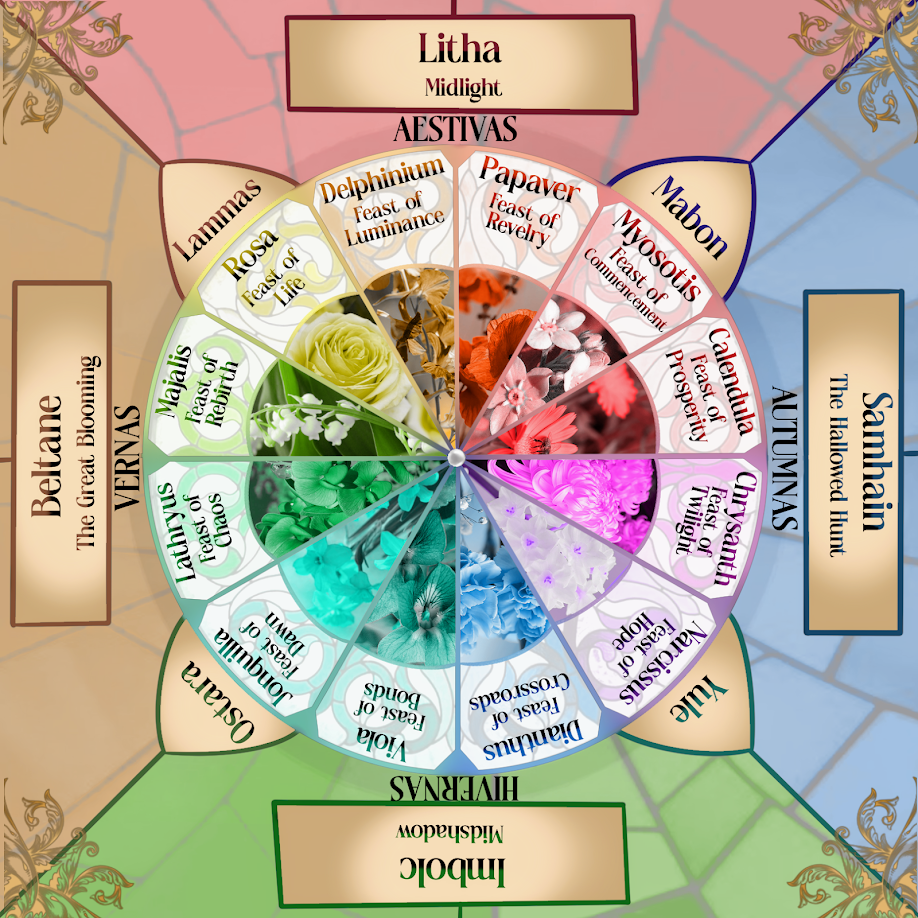
The Feast of Hope is Itraviel’s most important holiday. Taking place in late December (or 'Narcissus', to the Itraviens), it celebrates peace, community, and - as the name would suggest - hope, even in the face of adversity.
This holiday is rich in lore and tradition, dating back for generations. Originally based around the myth of the gods’ victory over Eira, the Demon Lord of Frost and Despair, the celebration has gone through some major shifts throughout the years.
In this brief overview, you will learn about the historical events that caused these shifts, as well as some of the Feast’s main traditions.
**Section I: Early Lore (The Gods and Eira)**
The original story behind the Feast of Hope is as follows:
At the dawn of Itraviel, while the gods continued their quest to build a thriving world, they faced Eira, the vain and bitter Demon Lord of Frost and Despair. He is said to take the form of a tall, thin man with short spikes of blond hair, pale blue skin, and - perhaps his most striking feature - enormous, white feathered wings. He wields an enchanted violin carved from ice, channeling his dark magic through his music.
In an attempt to halt the gods’ plans, Eira plunged the world into a deep, harsh winter. Through its frigid temperatures and horrible weather, the storm ruined nearly everything the gods had done thus far, severely impacting their progress. Seeing all their hard work ruined in an instant disheartened them, and their despair seemed to worsen the storm.
That was the key to Eira’s curse: the feelings of despair brought on by his storm were what sustained it. So long as the gods remained hopeless, the storm would continue to rage until everything truly was lost.
Eventually, the gods determined the correlation between their emotions and the endless winter and realized that even though they had suffered a major setback, there was always time to start anew, especially if they all worked together. Combining their powers and gifts, they were able to defeat Eira and end the cursed storm, leaving them free to continue their mission.
This is why, to this day, we celebrate the Feast of Hope.
**Section II: Later Additions (The Great Blizzard of Justaea)**
The first evolution of this holiday came amid the Great War. During the reign of tyrant Andras Nocturne, the kingdom of Justaea was ravaged by a massive snowstorm on the night of the Feast.
Since the war had already put a strain on their resources and livelihood, the citizens’ hope of surviving the blizzard was slim. Andras hoarded much of what remained for himself and his closest circle. exiling the remainder of the staff to face the harsh conditions outside the castle.
The citizens, inspired by the legend of the gods and Eira, banded together in an effort to save everyone. Any and all supplies would be shared by the community, making sure no one was left without. As well, if anyone needed someplace warm to wait out the night, people opened their homes, hearths, and hearts to guests, no matter who they were. Many lasting friendships and bonds were formed that night, and the Great Blizzard serves as a very good demonstration of Justaea’s spirit of unity and compassion towards others, one upheld to this day.
And although Justaea was under nigh-impenetrable surveillance at the time, the other kingdoms refused to leave Justaea to freeze. Each nation gathered a collection of necessary supplies to give to the endangered citizens. The only question that remained was how they could bypass Andras’ defenses and bring their haul to those who needed it.
This seemingly impossible task would not have been accomplished without the help of a mysterious stranger by the name of Nikolas. According to history, he visited every kingdom, collecting donations and carrying them on his flying sleigh. Once he had gathered all the supplies, he managed to infiltrate Justaea, going door-to-door and distributing the supplies the citizens needed, evading Andras’s guards at every turn. Most miraculously of all, he accomplished all this in a matter of hours, and his work was complete well before the blizzard hit.
Through the combined effort of the entire world, Justaea made it through the blizzard, with all its citizens alive and well. This ‘miracle’ lives on in history, and the Feast of Hope now serves to keep the memory of the event, and the spirit of unity created by it, alive.
(Note: it’s not known whether or not the mysterious stranger’s name really was Nikolas. The name ‘Nikolas’ means ‘victory of the people’, so it’s quite possible it was merely an alias. However, it was the only name he gave, so it is the name recorded in history.)
**Section III: A Blurred Line Between Fiction and Reality**
As with most of Itraviel’s historical events, there’s a wide belief that the story of the Miracle may tie into a greater battle between the forces of good and evil. The mythological version of the Miracle states that the Great Blizzard was summoned by Eira himself, in the very same manner as the ancient storm that cursed the gods.
This version of the story also states that Nikolas was the Paladin of the Elements, and he used his powers over wind and ice to navigate swiftly through the skies and withstand the harsh conditions brewing over Justaea. Another possibility is that Nikolas was the Paladin of Time, by the logic that his seemingly impossible trip could have only been accomplished through the use of temporal powers. Whatever the case, he seems to possess some form of divine power.
A common belief, which became a frequent piece of seasonal imagery, is that the flying sled in which Nikolas made his journey was pulled by ice demons known as ‘spectral riders’. These demons, formerly under Eira’s command, had been tamed and harnessed by Nikolas to use against their former master. It is said that these particular demons were invisible to most but appeared in a spectral, horse-like form to those who could see them.
Something that may lend credence to this particular tale is yet another historical fact linked to fiction. One of Andras’ generals, known as Weiss DuNord, seemed particularly determined to stop Nikolas. Weiss is widely believed to have secretly been Eira, disguised as a mortal. However, since Nikolas and Weiss both mysteriously vanished, there’s no way to confirm that the pair were anything more than average mortals (though their disappearances certainly support the theory.)
Another popular belief is that Nikolas may have been a seer, gifted with the incredibly rare ability to see into the future. According to accounts from the citizens of Justaea during the Blizzard, Nikolas seemingly knew exactly each household needed, and already had them prepared when he arrived. As well, some say that he called the citizens by their names, even though he should have not known such things.
A different story explaining his apparent omniscience is that he owned the Book of Eras, an enchanted tome that kept a record of every living being, past and present, who had ever lived on Itraviel. So the tale goes, after a dispute between the gods over who should own the powerful artifact, they decided to place it under the watchful eye of one of their Paladins. It is unknown, however, if this tale was originally about Nikolas, or if it had simply been attributed to him and the ‘true’ owner is one of his lesser-known brethren.
Another clue pointing to Nikolas’ mystical origins is that, although his journey was well-documented, the man himself was never caught in photos or videos. In any media that might have come close, he is mysteriously missing or otherwise obscured to the point of being imperceptible. As such, while eyewitness accounts share certain traits (long black hair, blue clothing, and — most notably — antlers), there is no concrete record of his appearance.
And, strangest of all, some claim that he was not a man at all, but a being known as the Winter King, said in folklore to wander the frozen wastes of Frosatir and guide those who have lost their way to safety. The Winter King shares many of Nikolas’ characteristics: power over ice and snow, a form of omniscience, and a devotion to helping others. Whether or not they are believed to be the same being, the King is often associated with and celebrated alongside Nikolas during Feast celebrations.
No matter the case, we may never truly know what he looks like. The last piece of evidence that points to Nikolas being a helper of the gods is the fact that before the Miracle, no one had ever heard of him, and afterward he was never seen again.
However, some claim that the world seems to be a bit more peaceful and runs a bit smoother on the day of the Feast, as if Nikolas is still around working his magic for the benefit of people everywhere. And, some people to this day report finding baskets of supplies they need on their doorsteps during Feast season, with no knowledge of where the mysterious gift came from…
Naturally, people throughout the generations have tried to catch Nikolas in the act and prove he’s still out there, but there’s been little to no success so far. Still, whether or not it’s truly him behind the mysterious acts of goodwill, the spirit of what he represents lives on.
**Section IV: Modern-Day Celebrations and Christmas**
Ever since Itraviel and Earth began exchanging their goods and culture, the Feast has become intertwined with the human celebration of Christmas.
For the longest time, the Feast had no set date, with the United Magical Assembly deciding when it would fall on a yearly basis. However, seeing as Christmas, a holiday with similar traditions and values, falls consistently on the 24th and 25th of December, the Assembly decided that the Feast would be held on those dates as well.
As for the Feast’s current traditions, they involve exchanging gifts, gathering with loved ones in celebration and, as the name suggests, a feast.
**Festivities:** One of the main celebrations of the Feast happens not on the day of the celebratory meal itself, but on the night before. Traditionally, large festivals and parties are held for people everywhere to unite in celebration, enjoy food, sing carols, and participate in fun activities.
Gift-giving is also a tradition during the Feast. Historically, gifts were purely handmade, as a way of using what you had to make something new and heartfelt. Over time, store-bought gifts have become much more popular, especially since the Feast became associated with Christmas, but the tradition of making your own gifts remains prominent as well.
**Decorations:** Traditional decorations share much in common with those of Christmas; as such, trees, stockings, nutcrackers, bells, glitter, and lights are present in nearly every Itravien home. Lights are an especially important aspect of the Elacantan holiday tradition: the feast overlaps with the celebration of Lumentide, an occasion to celebrate all things glowing and gleaming. Decorations resembling ice are also a widely popular choice, but these serve a superstitious purpose: by decorating your house with fake ice, it is believed that you can trick the Demon Lord into believing that his icy magic has already claimed your home, and he will leave you and your family be.
**Food:** Arguably the most important tradition of this holiday is the feast itself. The food served at this feast varies between kingdoms and families, so there’s no one “traditional” meal. That being said, the meal normally includes some form of winterroot, a hearty vegetable known for being able to survive harsh conditions. For example, Justaea has a traditional winterroot soup, dating back to the days of the Great Blizzard when the vegetable was one of the only crops that remained intact after the storm. Rosie’s Tavern, located in downtown Crown City, claims to have the original recipe for this soup, dating back to when it served as the secret hideout for the resistance during the war. Meanwhile, Elacanta, a kingdom known for its long, cruel winters, makes their winterroot into fried cakes formed from thin, shredded strips of the vegetable. The family-oriented kingdom of Aedere has a traditional meal prepared directly at the dinner table on a small grill, featuring a side dish of roasted and spiced winterroot. Traditional earthen Christmas meals such as turkey and ham have also become popular amongst Itraviens. Much like Earth, spiced, chocolatey, and minty desserts are a staple of the season. As for drinks, cocktails, cocoas, and ciders abound.
**Entertainment:** One of the biggest aspects borrowed from Christmas is the music. Earth’s seasonal tunes are played and enjoyed by the people of Itraviel during the Feast, although the two holidays are not quite the same. (And yes, the perennial hits by Wham! and Mariah Carey are just as overplayed.) Although the Feast of Hope has no association with the religious aspects of Christmas, music from that side of the season is often enjoyed for its beauty and solemn, reverent air.
During the season, Itravien television channels also broadcast human Christmas specials and movies, alongside their traditional films about the Feast. The legends of the Gods and the Miracle are a common subject for these specials, with many unique takes on their stories throughout the years. The First Miracle is a favorite retelling of many families, however, it has drawn some ire from the mythologically inclined for completely ignoring most of the established lore in favor of its interpretations.
**Folklore:** Many celebrants from both worlds have noticed some similarities between the debatably fictitious figures of Nikolas and Santa Claus (also named Nicholas in some iterations).
As such, the former has taken on some of the latter’s qualities in recent years:
Although Itraviel’s Nikolas is said to have had coal-black hair and a blue cloak, it’s not uncommon to see more modern depictions with white hair and a red cloak instead. In his iteration as the Winter King, he may also be depicted as a goat-man akin to Krampus.
The ice demons pulling his sleigh may also change in depiction from horses to reindeer. Nikolas’ spectral rider steeds also fill the role of his ‘worker elves’, with some stories claiming that the demons can assume humanoid form, working as Nikolas’ assistants.
Some speculate that his supposed seer abilities and/or possession of the Book of Ages are stand-ins for the Naughty and Nice lists, as well as Santa’s supposed ability to “see you when you’re sleeping, and know when you’re awake”.
Nikolas does not visit houses in the dead of night, but many in Frosatir leave out baskets on their doorsteps for the Winter King on Feast Eve as appreciation for his protection and prosperity through the cold winter months. In return, many have found a small gift or two once they bring in their baskets the next morning.
While Santa Claus is said to live in a mystical toy workshop in the North Pole, Nikolas supposedly lives in a grand palatial fortress hidden deep in the icy mountains of Frosatir.
Perhaps the best way to sum up the relationship between the two holidays is by comparing the stories of both Nicks; similar enough to relate to each other, while each having their own diverse charm to make them special.
**Bonus: The Ballad of the Miracle**
Mirroring the famous earthen poem known as ‘A Visit from St. Nicholas’ or ‘The Night Before Christmas’, famed Elacantan poet and royal advisor Eryx Farlaen penned a parody of sorts, centering around the Great Blizzard. It was found in his notebook and allegedly never meant to see the light of day, but the author of this text -- Farlaen’s own younger sister -- found it and took it upon herself to include it in this collection.
“T'was the eve of the Feast, and a blizzard did loom
A storm that would no doubt spell Justaea's doom.
Harsh weather and foul winds quickly drew near,
And the folk of the kingdom were quaking with fear.
The tyrant and his circle were snug in their castle,
And would never aid the ‘peasants’ in their hassle.
No one had enough to make it through,
And not one soul knew quite what they could do.
The generous opened their hearts and their homes,
Ensuring no one would be left all alone.
All food and clothing was gathered to share,
So each and every person in the realm could prepare.
Despite their best efforts, it still was not enough,
Surviving the weather would prove to be rough.
Allies collected donations and prayers,
But the question remained: how would help arrive there?
As if by magic, a savior did arrive,
To deliver the gifts and help Justaea thrive
His name it was Nikolas, and before day met night,
He would visit each kingdom through power of flight.
“On, Frostbite! On, Snowflake! On, Hailstorm and Glacier!
On, Bluster! On, Arctic! On, Iceberg and Powder!
To save the day, swiftly you must fly!
We’ve no time to waste, so take to the sky!”
On a sleigh carried forth by eight glacial horses,
Nikolas would defy nature’s powerful forces.
Every kingdom’s donations dutifully collected,
In the hopes that they’d help the poor souls affected.
As Nikolas prepared to make his descent,
Someone sought his miraculous plan to prevent.
A general serving the tyrant’s regime,
Was assigned to thwart the harebrained scheme.
Though the general was determined, Nikolas worked faster,
Of swiftness and power, he was a master.
He was faster than light, though his journey was fraught,
And he vanished into the night before he was caught.
But before the realm’s savior disappeared from view,
All through the air, a greeting rang through.
“Good night and good luck, fair souls in the storm!
Though the night is cold, may your hearts be warm!”